
Do People Still Buy Online Courses? 4 Honest Truths for 2026


“Courses are dead.” You have probably seen someone say it online, right before you quietly shelved the idea you had been sitting on for months. So let’s settle the question you are actually asking: do people still buy online courses?
Yes. People still buy online courses at every price point, in niches you would never guess. And the proof I want to show you is not some 2019 gold rush story. It happened months ago, from a brand new account, with a $297 price tag, created by a woman who had no idea what her business was going to be when she started posting. Her story makes four things obvious, and none of them are what the “courses are dead” crowd wants you to believe.

Do People Still Buy Online Courses? Jessi Jean’s $5 Million Answer
In November of 2025, Jessi Jean started a brand new Instagram account. She was not sure what direction her business was going to take, so she talked about career confusion and thought out loud about where she was headed.
Then something interesting happened. When she started talking about “yapping” on Instagram, people responded. She paid attention to that response, spotted a real need underneath it, and built a course around it: the Yap Challenge.
Her very first launch sold $1.2 million in one week.
Demand stayed strong, so she reopened the course a couple of weeks later. Total sales passed $5 million. And here is the detail I keep coming back to. This was not a premium $2,000 program. It was a $297 course.
So if you have been quietly wondering whether people still buy online courses, that is a fairly loud yes.
One caveat before we go further, because I care more about your actual business than about impressing you. Results like hers are rare, and anyone promising you her numbers is selling you something. I am not sharing this to set your expectations at seven figures. I am sharing it because of how it happened. The sequence she followed is the part you can copy, and it explains why people still buy online courses in a market everyone keeps calling saturated.
Truth #1: People Buy Solutions, Not Courses
Look at Jessi’s sequence again, because the order matters more than the outcome.
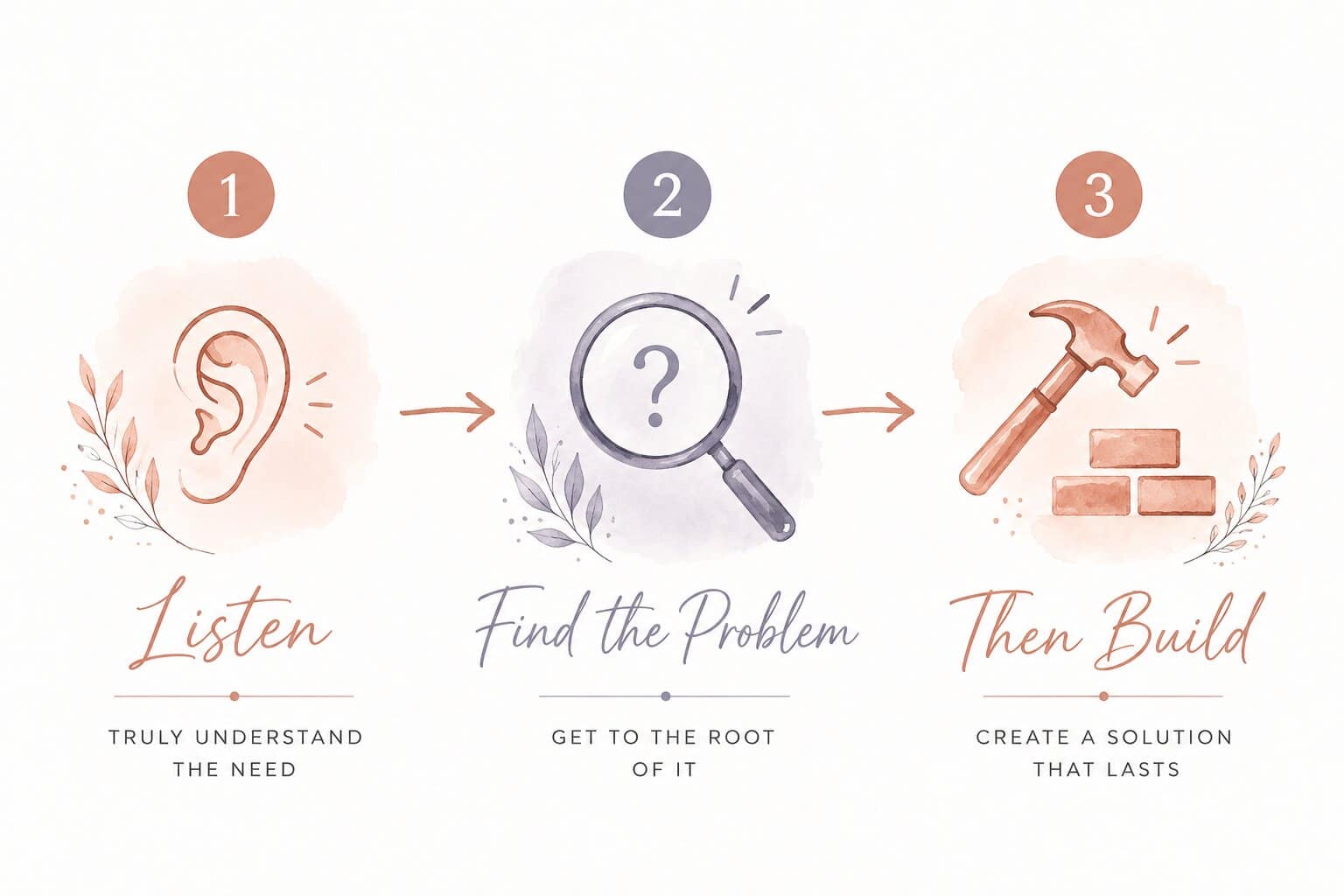
She did not start with a product idea she was attached to. Instead, she started by showing up and talking, with no fixed direction. Then she noticed what people responded to. She recognized that the response pointed to a real problem. Only after all of that did she build something.
That is the whole lesson, and it explains what actually makes someone buy online courses. The format was never the magic. A course sells in 2026 for exactly the same reason a course sold in 2016: someone on the other end thinks “this solves my exact problem” and reaches for her wallet.
Why “Courses Are Dead” Is Really a Different Complaint
When people say courses are dead, what they usually mean is that generic courses are dead. Honestly? They are right about that part.
A course teaching what a hundred other courses already teach, aimed at nobody in particular, solving nothing specific, will not sell. It would not have sold in 2016 either. There was simply less competition back then, so forgettable offers could hide in the crowd.
The market did not stop buying, in other words. It got pickier. Those are very different problems, and only one of them is yours to fix. Readers still buy online courses every day. They just refuse to buy the ones that could have been written by anyone, for anyone.
Truth #2: A Big Audience Is Not the Requirement
Here is the objection I hear most often: “Sure, but she already had an audience.”
Her account was months old. Not years. She built the following and the offer at the same time, in public, by talking about something people genuinely cared about.
This matters because audience size is the excuse most creators hide behind while they wait to feel ready. Meanwhile, small and engaged beats large and lukewarm almost every time. Two hundred people who feel understood by you will out-convert two thousand who followed you for a giveaway.
Plenty of people buy online courses from creators with tiny lists and unimpressive follower counts. They buy the ones that feel written specifically for them. So before you count yourself out over a follower number, check whether the offer is actually specific. Specificity is the thing doing the heavy lifting, not reach.
Truth #3: The Price Tag Was Never the Barrier
$297 is not a bargain-bin price. It is also not a luxury purchase. That number tells you something useful.
Her buyers were not spending because the course was cheap. They were spending because the outcome mattered more to them than the money, which is the only pricing math that has ever really applied.
So if you have been talking yourself into a $17 offer because you assume nobody will pay more, pause for a second. Nobody decides to buy online courses because of a discount, and price is almost never the reason someone hesitates. Cheap does not remove hesitation. Clarity does. When a reader understands exactly what changes for her, the price quietly becomes a detail.
Truth #4: Listening Beats Guessing Every Time
This is the step almost everyone skips, and it is exactly why so many digital products never sell. Creators start with “what do I want to make?” instead of “what does my audience need solved?”
Jessi did not guess. She listened first, then built. The creators whose readers buy online courses are rarely smarter than everyone else. They are just paying closer attention.
Where to Find the Problem Your Course Should Solve
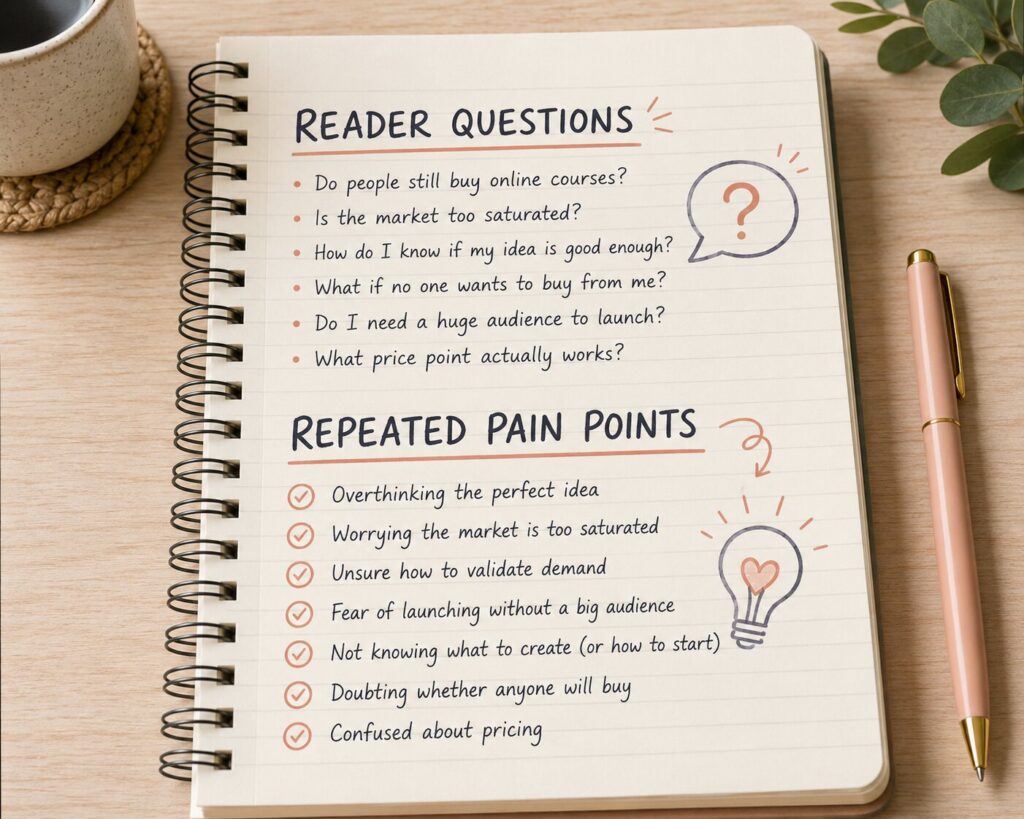
Good news: finding that problem is not luck. It is attention. The readers who would happily buy online courses from you are already telling you what they need, usually for free, usually more than once.
Look for the evidence in these places:
- The same question landing in your DMs every single week
- Email replies that start with “this might be a dumb question, but…”
- Blog comments where readers share their own messy workaround
- The thing you explain out loud so often that you are tired of explaining it
- Search terms bringing people to your site that you never intentionally targeted
Write those down for two weeks straight. Patterns show up faster than you would expect. And if a course is where you are headed, I go deeper on this in how to choose a course topic, where the goal is always to start with the problem instead of the format.
So Should You Create a Course in 2026?
Maybe. But that is the wrong first question, and asking it too early is how creators end up with a beautifully built course nobody wanted.
People still buy online courses, so that part is settled. The better question is what problem you are already positioned to solve, and what shape that solution should take. Sometimes the answer is a course. Sometimes it is a template, a workshop, a paid community, or something much smaller that sells quietly in the background.
Not sure which one is yours? My Digital Product Roadmap will show you. Answer 6 quick questions, about 2 minutes total, and it maps exactly where you are on the road to creating and selling your first digital product, plus the personalized next steps to get you there. No PDF to file away and forget about. It is a live tool that meets you right where you are.

Find Your Path with the Digital Product Roadmap
When you know what you are building and you want the step-by-step version of getting it launched, Course Creator Sprint covers the whole path from outline to open cart.
The Bottom Line
Do people still buy online courses? Yes, at every price point, in niches you would never expect, from creators who started far more recently than you assume. Jessi Jean sold millions of dollars of a $297 course from an account she had barely started.
But readers buy for the same reason they always have. The course solves a problem they are actively feeling. Start there, and the format takes care of itself.
You also do not need her numbers for this to be worth doing. A launch that brings in a few thousand dollars from a small, engaged audience is a real result, and it compounds from there. What you need is her sequence: listen first, find the problem, then build. That order is available to you today, whether your account is five years old or five weeks old.
And if you take one thing from this: people buy online courses that clearly solve something. Build that, and the rest is logistics.