
Have you ever asked AI to write an email or a caption for your business, read what it gave you, and thought, “Well, that sounds like a robot wearing my name tag”? You are not alone. The good news is that the problem usually is not the AI, and it is not you. If you want to train AI to write like you, it comes down to one thing: AI can only sound like you if it actually knows you.
Think about it this way. If you hired a brilliant writer off the street and said “write my newsletter,” she would hand you something generic too. Not because she lacks skill, but because she has never met your audience, never heard how you talk, and has no idea what you sell. AI works the same way. Before it can write like you, it needs to be introduced to your business the way you would introduce it to a new team member.
Here are the five things your AI needs to know before it can write anything that sounds like it came from you. Work through all five and you will train AI to write like you without needing a single clever prompt.
Why AI Writing Sounds So Generic
When you open a fresh chat and type “write me a welcome email,” the AI has nothing to go on except averages. It has read millions of welcome emails, so it gives you the average of all of them. Average vocabulary, average enthusiasm, average everything.
That is why better prompting alone will not train AI to write like you. You can add “make it friendly” or “make it casual” all day long, and you will still get a slightly friendlier version of average. Technique does matter, and Anthropic’s own prompt engineering best practices are worth reading. But technique cannot supply information the AI simply does not have. What changes everything is context. When AI knows your business deeply, the same short prompt produces writing that sounds surprisingly like you on your best day.
How to Train AI to Write Like You: Start Here
These are the five categories of context that make the difference. You do not need anything fancy to start. A document, a thoughtful hour, and some honesty about your business will get you further than a hundred clever prompts.
1. Your voice, in specifics
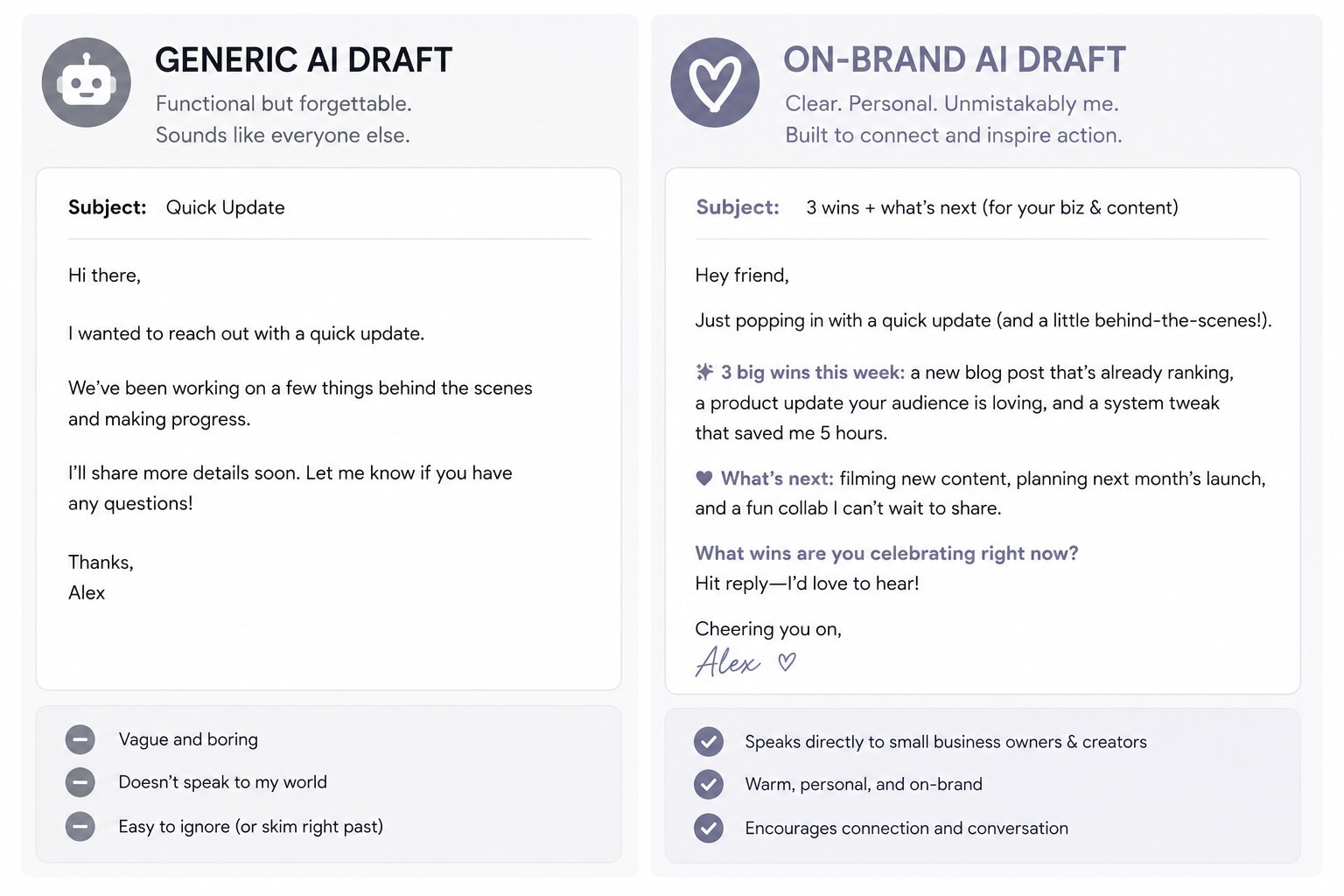
“Warm and friendly” is not a voice. Almost every business owner would describe herself that way, which is exactly why it does not help. Your AI needs specifics: the phrases you reach for, the ones you would never say, how you open emails, whether you use humor, how you handle a sales pitch without feeling pushy.
One of the fastest ways to capture this is contrast. Show AI a paragraph you wrote and a paragraph that sounds nothing like you, and tell it why. Those “never say this” examples are often more powerful than the positive ones. In fact, they do more to train AI to write like you than any list of adjectives.
2. Your customer, as a real person
AI writes to whoever you tell it to write to. If you have not told it anything, it writes to everyone, which reads like it was written to no one. So you cannot train AI to write like you without also telling it who you are writing to.
Your AI needs to know who she is, what she is struggling with right now, what she has already tried, and what she is afraid of. Not demographics. Reality. There is a big difference between “women 25 to 45 interested in food blogging” and “a talented home cook who has been posting recipes for two years and quietly wonders if her site will ever earn real income.”
3. Your products and how they connect
If AI does not know what you sell, it cannot naturally point people toward it. Worse, it might confidently make something up, and now your email references a course you do not offer.
Give your AI your full product list, what each one does, who it is for, and how your offers relate to each other. Which product is the natural first step? What does someone usually need next? When AI understands the journey, your calls to action stop feeling bolted on and start feeling like genuine next steps.
4. Your beliefs and point of view
This one gets skipped the most, and it is the one that makes writing feel like yours. Every business has opinions. Things you teach differently than everyone else in your space. Advice you disagree with. Hills you will happily die on.
Without your point of view, AI defaults to the same advice everyone else publishes. With it, your content starts sounding like it could only have come from you, because it could only have come from you. So if you only have time for one of these five, this is the one that will train AI to write like you fastest.
5. Your boundaries
Finally, your AI needs to know what it should never do. Maybe you never use fake urgency. Maybe you refuse to use shame as a marketing tactic. Maybe there are words you find cringey or claims you will not make.
Boundaries matter because AI is agreeable by default. It will happily write a countdown-timer pressure email if you ask, even if that would make your longtime readers wince. Telling AI what is off limits protects the trust you have spent years building. If you want to think through where your own lines are, I shared my approach in how to use AI ethically in your business.
Where Do You Keep All of This?
Here is where most people get stuck. You could paste all of this context into every single chat, but that gets old fast, and you will inevitably forget pieces. What you really want is a home for it: one organized place where your voice, your customer, your products, your beliefs, and your boundaries live, so every conversation with AI starts already knowing your business. Because that context lives in one place, you train AI to write like you once instead of re-explaining yourself every time you open a chat.
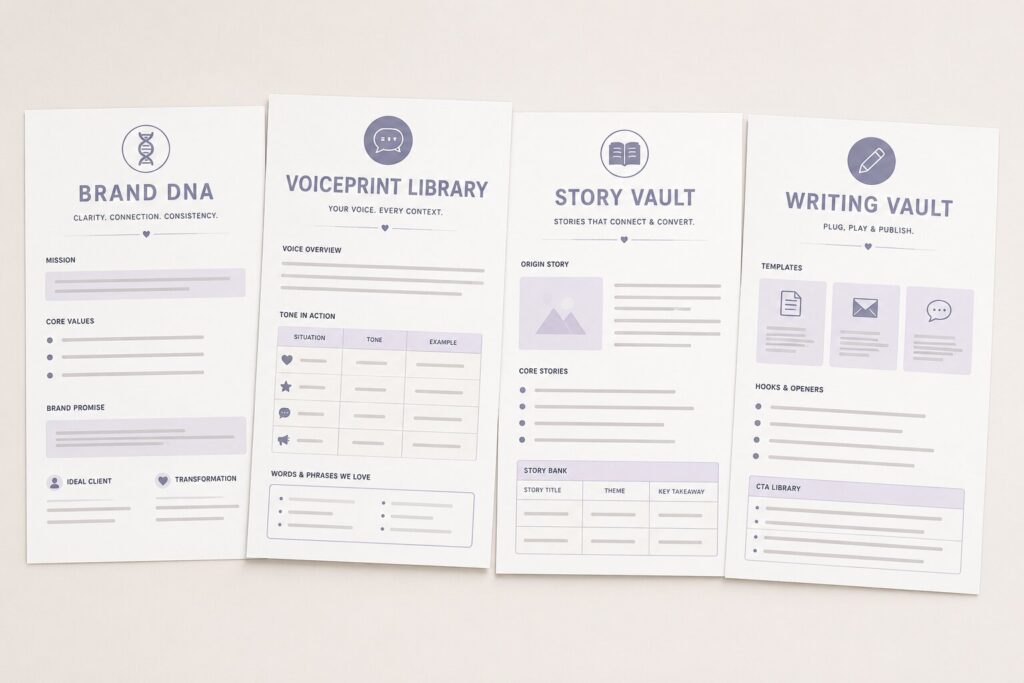
That is exactly what I call a Brand Brain, and building one is what we do together, step by step, inside the AI Brand Brain Workshop. You will walk away with AI that is trained on your business, so instead of editing robotic drafts, you are polishing writing that already sounds like you.
You built your business one intentional decision at a time. Teaching AI who you are is one more of those decisions, and it might be the one that gives you the most hours back. Train AI to write like you now, and every email, caption, and sales page you write after this gets easier.

Ready to Finally Get it Right!
If you want a step-by-step system for training AI on your brand voice so every piece of content sounds like you, the AI Brand Brain Workshop covers exactly that.
FAQs About How to Train AI to Write Like You
How long does it take to train AI to write like you?
Less time than you would think. One focused hour of writing down your voice, your customer, your products, your beliefs, and your boundaries will change every draft you get after that. You will keep refining it over time, but the first version does most of the heavy lifting.
Do I need a paid AI tool for this?
No. The five categories matter far more than the tool you pick. Whatever you use, you train AI to write like you the same way, by giving it real context before you ask it for anything.
Is this the same as writing better prompts?
Not quite. Prompts tell AI what to do right now. Context tells AI who it is writing as, and who it is writing to. Prompting helps, but you cannot prompt your way around missing information, which is why context is what actually lets you train AI to write like you.
What if my voice changes over time?
Then you update the document. Your business is not static, and neither is this. Revisit it once or twice a year so the notes you use to train AI to write like you still match how you actually sound.
What is the very first thing I should do?
Find two pieces of writing: one that sounds exactly like you, and one that sounds nothing like you. Then write a few sentences about why. That single contrast will improve the next draft you ask for.
Ready to turn your ideas into something more?
Our feminine WordPress themes are designed to help you build a beautiful, professional website — whether you’re starting a blog, selling products, or growing a business.